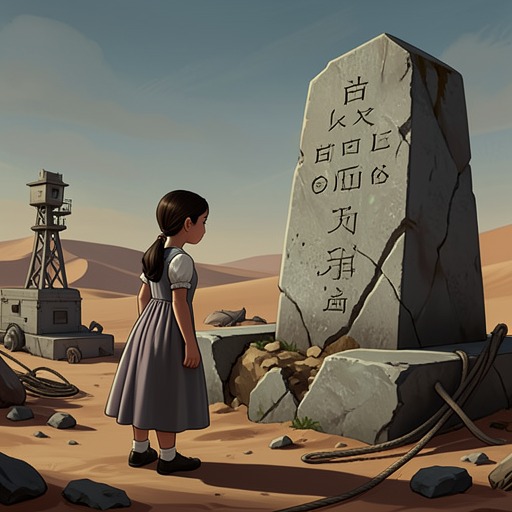
Stelae in Amenemhab’s Tomb
Theodosia and the Serpents of ChaosThe Stelae in Amenemhab’s Tomb give the tomb’s account of royal vengeance a visual form and connect it to the curse of the Heart of Egypt. Studied on a worktable as dusk approached, they repeat the message of Amenemhab’s secret writings on the art of war, but with images that make the threat legible as both military history and a warning about what follows the removal of the sacred object. Their central demand is conditional and explicit: the Heart must be returned to its rightful resting place for the devastation to end.
Images of an Army and Its Enemies
The stelae were spread across a worktable in the tomb, where Theodosia examined them closely. Their scenes showed the pharaoh’s army arranged in seemingly endless ranks, carrying spears, swords, and daggers. The figures’ grave expressions and the defeated enemies shown at the pharaoh’s feet present the army not simply as a force in battle but as an instrument of lasting royal punishment.
These images also prompted Theodosia to consider whether the tomb’s shabti figures might have a role beyond their usual association with the afterlife. She wondered whether they could rise when the tomb was disturbed. The stelae do not establish that this happens; rather, the possibility enters her mind as she studies the images of soldiers and considers the threat they might imply. The distinction matters: the figures on the stelae provide evidence of the tomb’s punitive message, while their possible connection to active shabtis remains a fear, not a confirmed event.
A Pictorial Account of the War Text
Later that afternoon, Theodosia continued studying the stelae and recognized that they told the same story as Amenemhab’s secret writings on the art of war. The pictures made that account vivid: what had been conveyed in writing was also presented through scenes of the army and its defeated enemies. The stelae therefore serve as a parallel record, joining image to text rather than introducing an unrelated narrative.
That repetition gives the war account a force beyond description. The army’s ranks and the consequences of its campaigns place the pharaoh’s authority at the center of the tomb’s memory. The written and pictured versions reinforce one another, presenting retribution as something meant to outlast the ruler’s death. In Theodosia’s reading, the images are not isolated decoration: they help her ask whether the soldiers and the tomb’s other contents form part of a continuing plan.
The Curse and Its Conditions
The stelae also set out the consequence for anyone who takes the Heart of Egypt away. Their appeal names a chain of calamities: illness, famine, and destructive flooding that would overwhelm the land. The warning moves from harm to people and their livelihoods toward a broader collapse of the land itself. It frames the removal of the Heart not as an ordinary theft but as an act with consequences that extend across an entire population.
The scenes give that threat a human face. Theodosia sees depictions of emaciated people resembling the haunted faces she had encountered in Seven Dials, as well as people visibly suffering from illness. The resemblance connects the tomb’s warning to signs already present in Britain, though the images alone do not prove their cause. They sharpen the significance of what she is reading: the stelae describe the very kinds of affliction she has seen beyond the tomb.
The warning does not leave the remedy unstated. Its appeal calls for the Heart of Egypt to be returned to its rightful resting place, linking the promised end of the calamities to the restoration of the object. That condition makes the stelae more than a record of past violence. They articulate the terms of an ongoing threat and identify the action required to reverse it.
Discovery Through Close Study
The stelae’s importance in the scene emerges through the time Theodosia spends with them. Absorbed in comparing their story with the war text, she fails to notice how late it has become; dusk falls, the room darkens, and a sound from the stair interrupts her study. The transition from careful reading to sudden alertness leaves the warning unresolved at the moment she encounters it. The stelae have explained the stakes, but the immediate danger in the room remains uncertain.
Their narrative role is thus both documentary and suspenseful. They supply concrete information about the curse’s predicted effects and its condition for reversal, while their military imagery prompts Theodosia’s further suspicions about what may happen inside the tomb. By presenting the same account in writing and pictures, they make the warning difficult to dismiss as a passing inscription: the tomb repeats its demand, and Theodosia recognizes that the Heart’s return is bound to the fate described there.